Blogs
The 2026 AI Content Engine: How Modern Teams Scale Output Without Losing Quality
Discover how AI content creation reshapes marketing velocity, multimodal workflows, brand consistency, and measurable revenue with modern hybrid strategies in 2026.
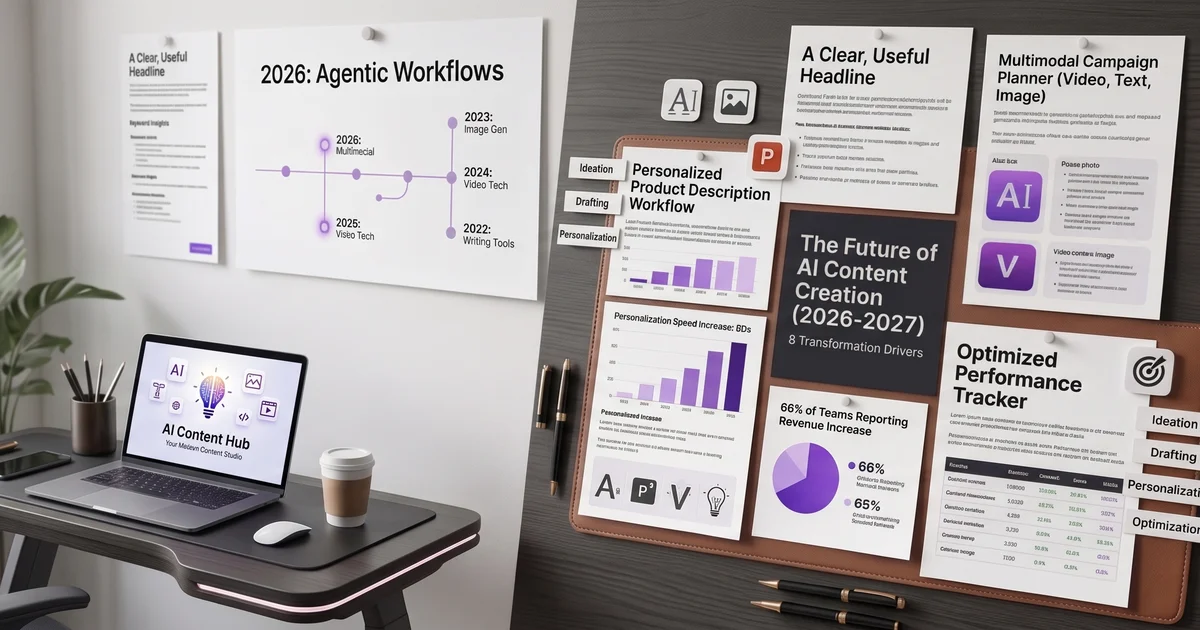
How AI Content Creation Transforms Your Marketing Output in 2026

The marketing landscape shifted permanently and most teams have not caught up. What once required a full team of writers designers and strategists working for a week can now be produced personalized and published in a single afternoon. That is measurable reality not hype.
AI has moved beyond being a peripheral tool. It is now the infrastructure underneath modern content marketing handling ideation drafting personalization optimization and performance measurement at a scale no human team can match alone. Marketing teams using generative AI can personalize content up to 50 times faster than manual approaches and 66 percent of marketing and sales teams using generative AI reported revenue increases over the prior 12 months.
This guide covers what a real marketing professional needs to act on that shift a clear definition of AI content creation eight ways it reshapes your output an honest tool comparison a seven step workflow a human plus AI hybrid model vertical specific use cases an ROI measurement framework what AI cannot yet do ethical and legal guidance and where AI content creation is heading through 2026 and into 2027.
What Is AI Content Creation A 2026 Definition
AI content creation uses artificial intelligence including large language models generative image tools AI video engines and predictive analytics to automate personalize and optimize marketing content across every channel and format. It ranges from a 2000 word SEO blog post drafted by a GPT class model to a product image generated by Adobe Firefly to an email sequence dynamically rewritten for 40 different audience segments before a single send.

How AI Content Creation Differs from Traditional Content Production
Traditional content production is linear and labor intensive. A strategist writes a brief, a writer drafts it, an editor refines it, a designer adds visuals and an SEO specialist optimizes it often across days or weeks. Each piece is built once and published to a broad audience with minimal variation.
AI content creation breaks that model. A single content brief generates dozens of variations simultaneously. Images copy subject lines and calls to action adapt in real time based on who views them. Performance data feeds back into the generation process automatically. The cycle compresses from weeks to hours and output volume scales without proportional increases in headcount.
The Core Technologies Behind AI Content Creation
Several distinct technologies combine to make modern AI content creation work:
- Large Language Models LLMs: GPT 4o from OpenAI and Claude from Anthropic power most AI writing and copywriting tools generating human quality text from structured prompts.
- Natural Language Processing and Generation NLP NLG: These branches of machine learning allow AI to understand context sentiment and tone producing text that reads naturally rather than mechanically.
- Generative image models: Diffusion model architecture like Midjourney and DALL-E produces original visual assets from text descriptions.
- Computer vision: AI systems analyze existing visual content to inform creative decisions brand consistency checks and audience engagement predictions.
- Predictive analytics: Machine learning models analyze historical content performance data to recommend topics formats headlines and distribution timing before a piece is written.
- Retrieval Augmented Generation RAG: This architecture grounds LLM output in real up to date source material reducing hallucinations and improving factual accuracy for brand specific content.
Understanding these building blocks matters because the tool for email personalization should be evaluated differently from the tool for AI generated product photography. The technology underneath shapes the output ceiling.
The 8 Ways AI Content Creation Transforms Your Marketing Output
The benefits of AI content creation are concrete and measurable. Here is how AI reshapes output across eight dimensions:
1 Create Personalized Content at Scale
Content personalization at scale means producing distinct content variations for different audience segments buyer,personas, geographic regions or individual users automatically without rebuilding each asset from scratch. An e-commerce brand can generate 500 unique p roduct descriptions each tuned to a specific search intent in less time than a human writer takes to produce 20. A SaaS company can serve different blog CTAs to a first time visitor versus a returning subscriber without writing a single manual rule.

2 Launch Campaigns in Hours Not Weeks
The compression of content velocity is one of the most immediate impacts of AI. AI enabled teams move through the ideation to publish cycle at a fraction of the traditional timeline. Brands that previously planned quarterly campaigns can now respond to cultural moments competitor moves or search trend spikes within hours.
3 Generate Multimodal Content Text Image and Video
Text is only one dimension of modern marketing. In 2026 AI content creation is fully multimodal. Adobe Firefly generates on brand imagery from text descriptions. Runway ML produces short video clips and social reels from simple prompts. OpenAI DALL-E creates illustrations and product mockups. Canva AI assembles branded social graphics. Marketing teams now produce complete campaign assets copy visuals and video from a unified AI assisted workflow rather than coordinating separate vendors

4 Automate Repetitive Content Tasks
Tasks that drained creative teams for years such as meta descriptions alt text email subject line variants social post adaptations of blog content and product category page copy are now handled automatically. Marketers who once spent 60 percent of their time on production now redirect that capacity toward strategy creative direction and audience insight.
5 Optimize Content Performance in Real Time
AI marketing platforms analyze content performance signals click through rates scroll depth conversion rates bounce rates and recommend or automatically apply optimizations without waiting for a quarterly review. AB testing that once required weeks of traffic accumulation now runs at machine speed with the winning variant promoted automatically once statistical significance is reached
6 Improve Audience Targeting with Predictive Intelligence
AI driven audience segmentation moves beyond demographic buckets. Machine learning models analyze behavioral signals pages visited content consumed purchase history email engagement patterns to predict what content a specific user needs next and when they are most receptive to it. Platforms like HubSpot and Salesforce Marketing Cloud integrate these predictive signals directly into content distribution workflows.
7 Maintain Brand Consistency Across Every Channel
Brand voice AI fine tuned on your existing content library style guide and brand guidelines produces output that sounds like your brand not a generic AI. Tools like Jasper AI allow teams to train custom brand voices that persist across every content type and author eliminating the inconsistency that plagues teams scaling content across freelancers and multiple markets.
8 Connect Every Content Asset to Measurable Revenue
Attribution modeling has historically been one of the hardest problems in marketing. AI powered marketing platforms now map individual content assets to pipeline stages and revenue outcomes with precision that was impractical with manual analytics. Marketers can see exactly which blog post email variant or landing page copy drove a conversion and feed that intelligence back into future content decisions.
66 percent of marketing and sales teams using generative AI reported revenue increases over the prior 12 months per McKinsey Global Institute.
AI Content Creation Tools in 2026 The Neutral Comparison
The AI content tool market has matured significantly. Below is a breakdown of the leading tools available in 2026:
- Stichd AI: Best for full AI content workflows from brief to publish. Features end to end AI content creation with brand voice SEO and performance integration. Offers competitive all in one pricing and is ideal for marketing teams wanting a single platform.
- Jasper AI: Best for brand consistent content at scale. Features custom brand voice training and multi channel templates. Pricing starts from about 49 dollars monthly and is ideal for mid market to enterprise teams.
- Copy ai: Best for fast short form copy. Features workflow automation and go to market use cases. Offers a free tier with paid plans starting from about 36 dollars monthly for small teams and solo marketers.
- ChatGPT GPT 4o: Best for long form drafting and brainstorming. Features broad conversational capabilities and custom GPTs. Offers a free tier with Plus at 20 dollars monthly for marketers with prompt engineering skills.
- Adobe Firefly: Best for brand safe AI image generation. Features licensed training data and Creative Cloud integration. Included in Creative Cloud plans for design teams and enterprise brands.
- Runway ML: Best for AI video marketing. Features text to video and image to video rendering starting from 12 dollars monthly for social media and video marketing teams.
- Semrush AI: Best for SEO content optimization. Features AI driven briefs and SERP analysis starting from 140 dollars monthly for SEO teams and content strategists.
- Surfer SEO: Best for on page content scoring. Features real time SEO grading and AI outlines starting from 79 dollars monthly for content writers and agencies.
To choose a tool follow this framework:
- Identify your primary content type whether written copy images video or mixed.
- Assess the technical comfort level of your team because some tools require prompt engineering skill while others are point and click.
- Match your budget tier as enterprise platforms require significant investment while simpler tools offer accessible entry points.
- Prioritize brand safety if you operate in a regulated industry.
- Choose a single platform like Stichd AI if you want coverage across the entire content lifecycle from brief to performance tracking.
Step by Step AI Content Creation Workflow for Marketing Teams
Here is a repeatable process your team can run from day one.
Step 1 Define Your Content Strategy and Objectives
Before any AI tool opens answer three questions: Who is this content for What action do we want them to take How will we measure success. Set measurable targets such as organic traffic lead volume email open rate and conversion rate so AI generated performance data has a benchmark to compare against.
Step 2 Build Your AI Content Brief and Prompt Framework
A strong AI prompt is the difference between generic output and on brand high quality content. Build a master prompt template that includes your brand voice description target audience persona content goal primary keyword required tone word count and any factual constraints. Save these as reusable prompt templates in your AI platform of choice.
Step 3 Generate First Drafts and Multimodal Assets with AI
Run your brief through your AI writing tool for text your image generator for visual assets and your video tool for any motion content. Generate at least two to three variants per major content element such as headline intro and CTA so your team has options to evaluate rather than a single output to accept or reject
Step 4 Human Review Brand Voice Accuracy and Originality Check
This step is non negotiable. A human editor reviews every AI generated draft for factual accuracy brand voice alignment originality and genuine value.
Feed the reviewed draft into your SEO optimization tool to check keyword coverage semantic richness and on page elements. Adapt the content for each distribution channel with custom metadata platform formatting and copy variations.
Step 6 Publish Distribute and AB Test
Schedule and publish through your CMS and distribution platforms. Set up AB tests for any variable element like subject lines headlines CTAs and image variants using your marketing automation platform. Define the winning metric and traffic threshold before the test runs so decisions remain data driven.
Step 7 Analyze Performance and Feed Data Back to AI
After sufficient data accumulates pull performance metrics and identify what worked. Feed winning patterns such as headlines angles formats and CTAs back into your prompt framework as examples for future generation cycles.
AI Content Pre Publication Quality Checklist
- Every factual claim verified against a named source
- Brand voice reviewed by a human editor
- No AI hallucinations present in names statistics or URLs
- SEO metadata complete with title meta description and canonical tag
- Primary and semantic keywords present naturally
- Internal links added where relevant
- Image alt text written and descriptive
- Mobile formatting verified
- CTA is clear and channel appropriate
- AI disclosure applied if required by platform or brand policy
The Human Plus AI Hybrid Model Who Does What
The best performing content teams in 2026 are neither fully automated nor fully manual. They are hybrid teams where AI handles volume and speed while humans provide creativity judgment and brand voice.
What AI Handles Best
- High volume templated content like product descriptions meta tags social posts and email subject lines
- First draft generation for long form content
- Content variation for AB testing
- Real time personalization of dynamic content blocks
- Keyword research and content gap identification
- Performance data analysis and insight summaries
- Content repurposing across multiple channels
What Humans Must Own
- Content strategy and editorial direction
- Brand voice definition and enforcement
- Factual research source verification and accuracy review
- Creative concepting and original thinking
- Audience empathy and emotional intelligence in storytelling
- Ethical judgment calls regarding what to publish
- Relationship driven thought leadership content
- Final publication approval
The Collaboration Workflow in Practice
In a high performing hybrid team a strategist defines the content goal and audience. The AI generates a research brief and initial keyword recommendations. The strategist reviews and refines the brief. The AI produces a first draft and headline variants. An editor reviews for brand voice accuracy and originality. The AI produces SEO optimized metadata and social distribution copy. A channel manager schedules and activates the campaign. The AI monitors performance and surfaces optimization recommendations. A strategist decides which recommendations to implement.
Human vs AI Content Responsibilities
- Content strategy: Research support by AI with full human ownership for a recommended split of 90 percent human.
- Content brief creation: Template generation by AI with human review and refinement for a recommended split of 60 percent human.
- First draft writing: AI acts as primary author with human editing and refinement for a recommended split of 70 percent AI.
- Factual verification: No AI role because models cannot self verify with full ownership owned 100 percent by humans.
- SEO optimization: Keyword and structure recommendations by AI with final human decisions for a balanced 50 50 split.
- Visual asset creation: Generation of options by AI with human selection and brand review for a recommended split of 60 percent AI.
- AB test setup: Variant generation by AI with human test design and analysis for a recommended split of 60 percent AI.
- Performance reporting: Data aggregation and summary by AI with human insight and action for a balanced 50 50 split.
- Brand voice enforcement: Style guide adherence by AI with human override and correction for an 80 percent human split.
- Publication approval: No AI role with final approval owned 100 percent by humans.
AI Content Creation by Audience Type Vertical Specific Use Cases
Generic AI advice fails most teams because a large digital agency has completely different needs from a solo founder. Here is how AI content creation applies across major marketing verticals.
AI Content Creation for E commerce Brands
E commerce teams face a heavy content volume demand across thousands of product pages each needing unique conversion optimized copy meta descriptions and image alt text. AI solves this directly by generating copy at scale from structured product data feeds dynamic banners and triggered email campaigns.
A quick win for e commerce teams is to feed catalog data into an AI copywriting tool and generate unique SEO optimized descriptions for the lowest performing pages to improve organic search visibility.

AI Content Creation for Digital Agencies
Agencies face client specific brand voice requirements across dozens of accounts alongside tight turnaround windows. AI content creation works best for agencies when each client has a dedicated brand voice profile and when AI handles first draft production so human strategists can focus on client counsel.
A quick win for agencies is to build a client specific prompt library capturing individual voice rules audience personas and approved messaging to cut production time significantly.
AI Content Creation for Brand Managers and Creative Directors
Brand managers prioritize protecting brand integrity. For brand leaders the most powerful AI application is content consistency checking using AI to audit existing libraries against brand guidelines and flagging tone deviations
A quick win for brand managers is to run an AI audit across recent publications to identify and fix voice gaps in a fraction of the time manual review requires.
AI Content Creation for Growth Marketers
Growth marketers rely on speed and experimentation. AI acts as an accelerator for testing by producing dozens of ad variants and multiple landing page versions optimized for different traffic sources.
A quick win for growth marketers is to generate ten headline variants for a high traffic page AB test them over two weeks and deploy the winner before testing secondary page elements.
AI Content Creation for Influencers and Individual Creators
Individual creators must maintain consistent output across multiple channels simultaneously. AI tools help creators repurpose a single core script into a newsletter social thread captions and articles rapidly while keeping their authentic perspective intact.
A quick win for creators is to record a voice memo on a trending topic transcribe it and adapt that transcript into platform specific formats to multiply reach with minimal friction.
How to Measure AI Content Creation ROI
Most AI content adoption stalls when teams cannot prove return on investment to budget stakeholders. Here is a framework that makes content ROI measurable and defensible.
The Metrics That Actually Matter
Focus on metrics that connect content to business outcomes:
- Content production velocity measuring output before and after AI adoption.
- Cost per content asset calculated from total production spend divided by assets created.
- Organic traffic growth from AI assisted content.
- Conversion rate of AI generated pages and emails compared against control versions.
- Pipeline attribution showing revenue from deals touched by AI content.
- Customer acquisition cost trends over time.
Setting Your Baseline Before AI Adoption
Document your starting metrics across production speed performance benchmarks and quality engagement before deploying AI tools so you have clear evidence of impact.
The AI Content ROI Calculation Framework
Calculate ROI by subtracting the total cost of tools and team time from the attributed revenue dividing that number by the total cost and multiplying by 100.
Core Metrics to Track
- Content production velocity: Measure assets published monthly aiming for 2 to 3 times the baseline within 90 days using an internal tracking sheet.
- Cost per content asset: Measure total cost divided by total assets targeting a 40 to 60 percent reduction verified via finance reporting.
- Organic traffic growth: Track session volume from search content aiming for a 20 to 30 percent increase within 6 months using Google Analytics and Semrush.
- Email open rate: Conduct AB tests comparing AI variants against control lines targeting a 10 to 15 percent improvement using HubSpot or Mailchimp.
- Conversion rate: Track lead form completions per page visit aiming for a 5 to 20 percent improvement on optimized pages via Google Analytics.
- Pipeline attribution: Measure revenue from content touched deals evaluated per campaign through your CRM system.
- Customer acquisition cost: Measure total acquisition spend divided by new customers looking for a declining trend over 6 to 12 months using finance and CRM data.
AI Content Creation Limitations What AI Cannot Yet Do
Understanding where AI breaks down separates teams that succeed from teams that struggle.
Hallucinations and Factual Accuracy Risks
Language models generate plausible sounding text which is not always factually accurate. AI models can fabricate statistics and misattribute quotes. Every factual claim in AI generated copy must be verified by a human against a verified source prior to publishing.
Brand Voice Erosion and Generic Output
Without careful guidance AI content gravitates toward a generic tone. Maintaining character and brand voice requires deliberate prompt structures custom model instructions and ongoing human editorial oversight.
Thin Content and Search Quality Standards
Search engines explicitly target low effort content that exists solely to rank without providing genuine value. Unedited shallow AI text carries a high risk of poor visibility. The solution is the hybrid model where AI builds structure and humans add direct insight and experience.
Originality and the Human Creativity Gap
AI recombines existing patterns from training data and lacks genuine personal experience or lived perspective. Distinctive industry thought leadership still requires human creative direction.
Legal Copyright and IP Considerations
Purely AI generated content without human creative authorship does not qualify for copyright protection under official guidelines. Human creative contribution through prompting curation and substantial editing establishes protectable ownership.
Ethical and Legal Considerations for AI Generated Marketing Content
 These considerations are essential for any team publishing AI content at scale.
Disclosure Guidelines
Regulatory guidance emphasizes that consumers should not be misled by artificial content. Clear disclosures are essential when deploying synthetic personas virtual presenters or automated testimonials.
Copyright Ownership
Ensure meaningful human creative contribution at the editing and directorial level to secure proprietary ownership over marketing assets.
Consumer Trust and Transparency
Transparency builds brand equity. Acknowledging AI assistance where appropriate reinforces trust and positions a business as transparent and forward thinking.
Platform Specific Policies
Review the content and advertising policies of search engines and social platforms regularly to ensure compliance with emerging AI labeling and disclosure standards.
The Future of AI Content Creation Trends for 2026 and Beyond
Here is where the technology and workflow practices are heading
Agentic AI and Autonomous Campaign Management
Agentic systems that can plan execute and refine multi step marketing tasks autonomously are moving into live environments. Humans will increasingly direct high level strategy while autonomous systems handle real time execution.
Real Time Individual Level Personalization
Broad demographic segmentation is evolving into hyper personalization where messaging and creative adapt in real time based on an individual browsing and purchase journey.
Interactive and Immersive Formats
AI output is expanding beyond static text and imagery into dynamic quizzes interactive visual models synthetic voice experiences and augmented reality assets.
Voice and Conversational Marketing
As conversational interfaces expand content structured around natural language questions and dialogue will perform more effectively across AI search tools.
Key Preparation Steps for Marketing Teams
- Build clean consented first party data infrastructure
- Develop prompt engineering as a core team capability
- Document human creative contribution for ownership protection
- Pilot automated campaign workflows in low risk channels first
- Establish an AI content governance policy covering tool usage and review standards
AI Content Creation Evolution Milestones
- 2022: Mainstream emergence of generative writing tools with the launch of ChatGPT.
- 2023: Broad adoption of generative visual creation tools like Midjourney and DALL E.
- 2024: Marketing grade video generation tools like Runway and Sora emerge.
- 2025: Multimodal AI campaigns become common enterprise practice.
- 2026: Agentic workflows begin managing multi step campaigns autonomously.
- 2027 Projected: Real time individual level personalization becomes standard table stakes.
Frequently Asked Questions About AI Content Creation

What is AI content creation in marketing
It is the use of artificial intelligence tools to produce personalize and optimize marketing assets across text visuals video audio and distribution channels.
How does AI content creation improve marketing ROI
It lowers asset production costs accelerates publishing velocity and expands creative testing capacity to drive faster revenue impact
What are the best AI tools for content creation in 2026
Leading platforms include Jasper AI for structured copywriting Copy ai for short form text ChatGPT and Claude for research and drafting Adobe Firefly for visual generation Runway ML for video creation Semrush for search optimization and Stichd AI for full end to end multimodal creation with persistent identity management.
Can AI replace human content creators
No. AI handles repetitive high volume tasks while humans provide strategic direction authentic perspective empathy and final editorial judgment.
How do I maintain brand voice when using AI for content
Define clear brand voice guidelines encode those rules into system prompts and require human editorial review on all final drafts before release.
Is AI generated content penalized by search engines
Search engines evaluate content based on overall utility accuracy and user satisfaction rather than the tools used to draft it. Low quality unedited filler is what loses search visibility.
How long does it take to implement an AI content workflow
A basic workflow can launch within a week while an integrated system with brand training and automated testing typically takes four to eight weeks to calibrate fully.
What types of marketing content can AI create
AI can produce articles social updates product pages ad copy video scripts visual assets short form video sequences and dynamic personalization modules.
How do I measure the success of AI generated content
Compare output velocity cost per asset organic traffic growth email engagement rates and attributed pipeline revenue against baseline pre AI numbers.
What are the biggest risks of using AI for marketing content
Key risks include factual hallucinations brand voice dilution unhelpful thin copy legal ownership concerns and regulatory disclosure compliance. All are manageable with human review processes.
Start Transforming Your Marketing Output with AI Today
The marketing teams gaining a competitive edge are those embedding AI as an operational capability.
Checklist to get started:
- Audit your current production workflow and record baseline metrics
- Select a single high volume content format for an initial pilot
- Choose tools aligned with your team size and workflow requirements
- Formalize brand voice guidelines and encode them into prompts
- Build master prompt templates and run test generations
- Assign an editor to manage quality control
- Implement AB testing to compare AI assets against control content
- Refine prompts based on initial performance data
- Expand AI workflows to secondary content formats
- Establish an internal AI governance policy